 Travis Springer
64% of former employees could still reach sensitive company information after their last day, and a third say their employer took none of the standard offboarding steps.
An employee’s last day usually has a routine. They hand over a laptop and walk out with a final paycheck on the way. On paper, the job is over.
The digital side of that exit often isn’t finished. Email keeps syncing to a personal phone. A login to the CRM or a shared drive still works weeks later, and sometimes nobody at the company knows.
Sagiss surveyed 1,000 U.S. adults about what happened to their work access after they left a job. The 2026 Sagiss Managed Security Report: Employee Offboarding shows how often that access outlasts the job and what former employees could still see once they were gone.
About the 2026 Sagiss Managed Security Report: Employee Offboarding
The 2026 Sagiss Managed Security Report: Employee Offboarding surveyed 1,000 U.S. adults who left a job in the past five years that involved computers or company systems. Sagiss conducted the survey in September 2026 using Pollfish. It measured which work accounts and systems kept working after former employees left and what their employers did to shut off access. Sagiss is a Dallas-based managed IT and cybersecurity provider.
Key Employee Offboarding Statistics for 2026
Source: 2026 Sagiss Managed Security Report: Employee Offboarding, survey of 1,000 U.S. adults.
- Most former employees had access that outlasted the job. 79% say at least one work account or access point kept working after their last day, and 44% had three or more.
- Sensitive information stayed within reach. 64% could still see or reach at least one category of sensitive company information, including customer or client information (29%) and financial records or payment systems (26%).
- The access often lasted for weeks or longer. 30% say their access lasted more than a month or still works today.
- Reporting the problem didn’t always fix it. Of the former employees who told their old employer their access still worked, 31% say it was still working more than a week later.
- Collecting the laptop didn’t close the accounts. 82% of former employees whose employer collected their equipment still had at least one account or access point working afterward.
- Nobody clearly owned the logout for a third of workers. 33% say it wasn’t clear who was responsible for shutting off their access or that no one seemed to be handling it.
- Smaller employers left more access open. 82% of former employees who left companies with fewer than 250 employees had lingering access, compared with 70% at companies with more than 1,000.
What keeps working after the last day?
79% of former employees say at least one work account or access point kept working after their last day.
2026 Sagiss Managed Security Report: Employee Offboarding
Email was the most common loose end. A third of former employees (33%) could still log in to their work email, and 25% say it kept syncing to a phone or computer. About a quarter could still open shared files or folders (25%) or kept getting meeting invites and calendar updates (24%).
The list goes well past email. Former employees say they could still use a company AI tool or assistant (24%), log in to work software like a CRM or payroll system (19%), connect to the company VPN (17%) or badge into the building (17%). Only 9% say nothing was still working after they left.
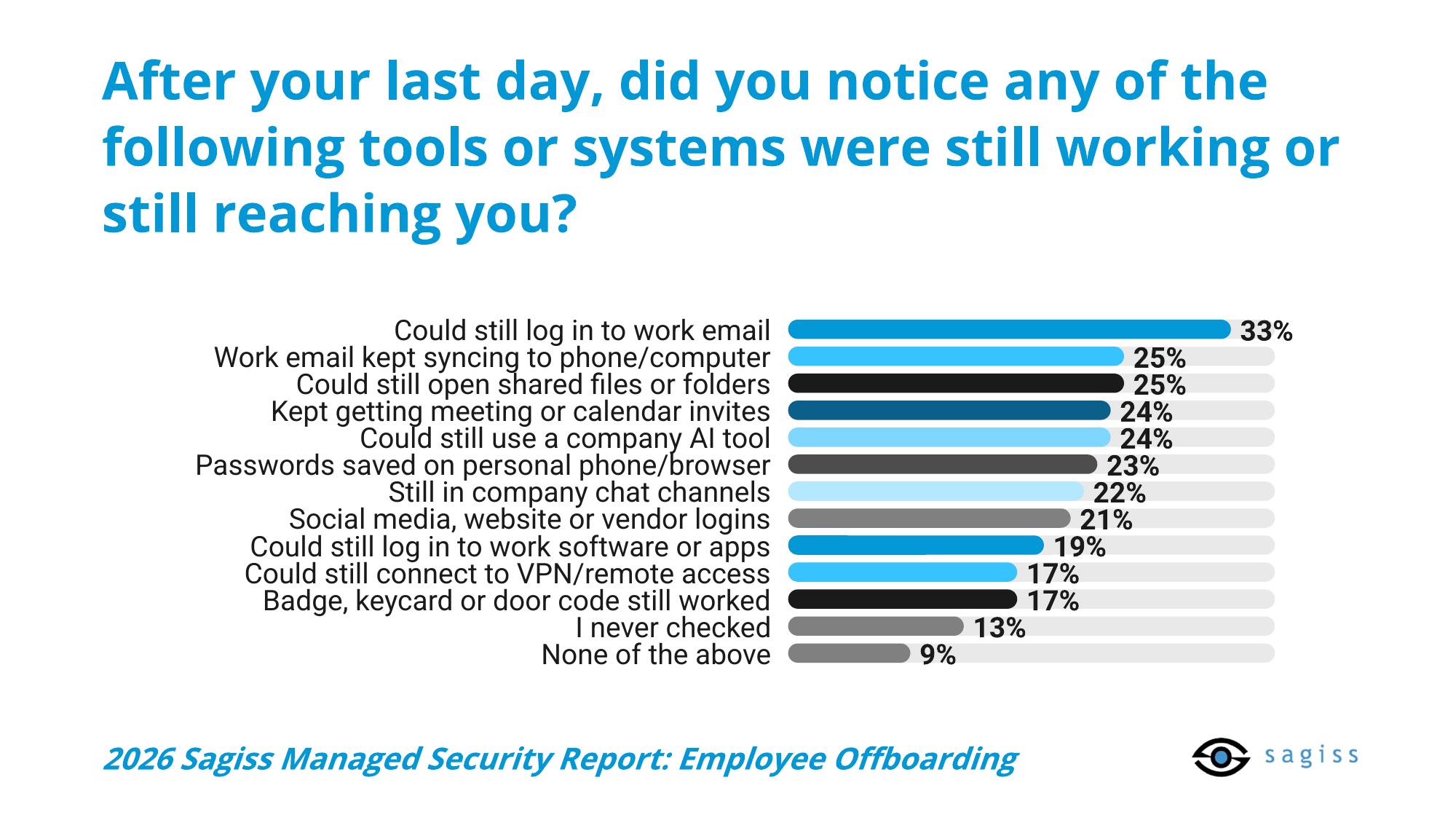
79% of former employees say at least one work account or access point kept working after their last day, led by work email logins at 33% and synced email at 25% (2026 Sagiss Managed Security Report: Employee Offboarding)
Most former employees expected a clean break. On their last day, 62% were completely or very confident that all of their work accounts had been shut off. Among those confident former employees, 78% later found at least one account or access point still working. That’s nearly the same rate as all other former employees (79%).
For many, the access wasn’t a matter of hours. Thirty percent say it lasted more than a month or still works today, and 12% say that as far as they know, their old access still works right now.
What former employees could still see
64% of former employees could still see or reach sensitive company information after they left.
2026 Sagiss Managed Security Report: Employee Offboarding
The accounts that stayed open often led to data a company would want protected. After leaving, 29% of former employees could still reach customer or client information, and 26% could reach financial records or payment systems. Another 22% could still see employee or HR records, and 17% still had admin accounts or shared company passwords.
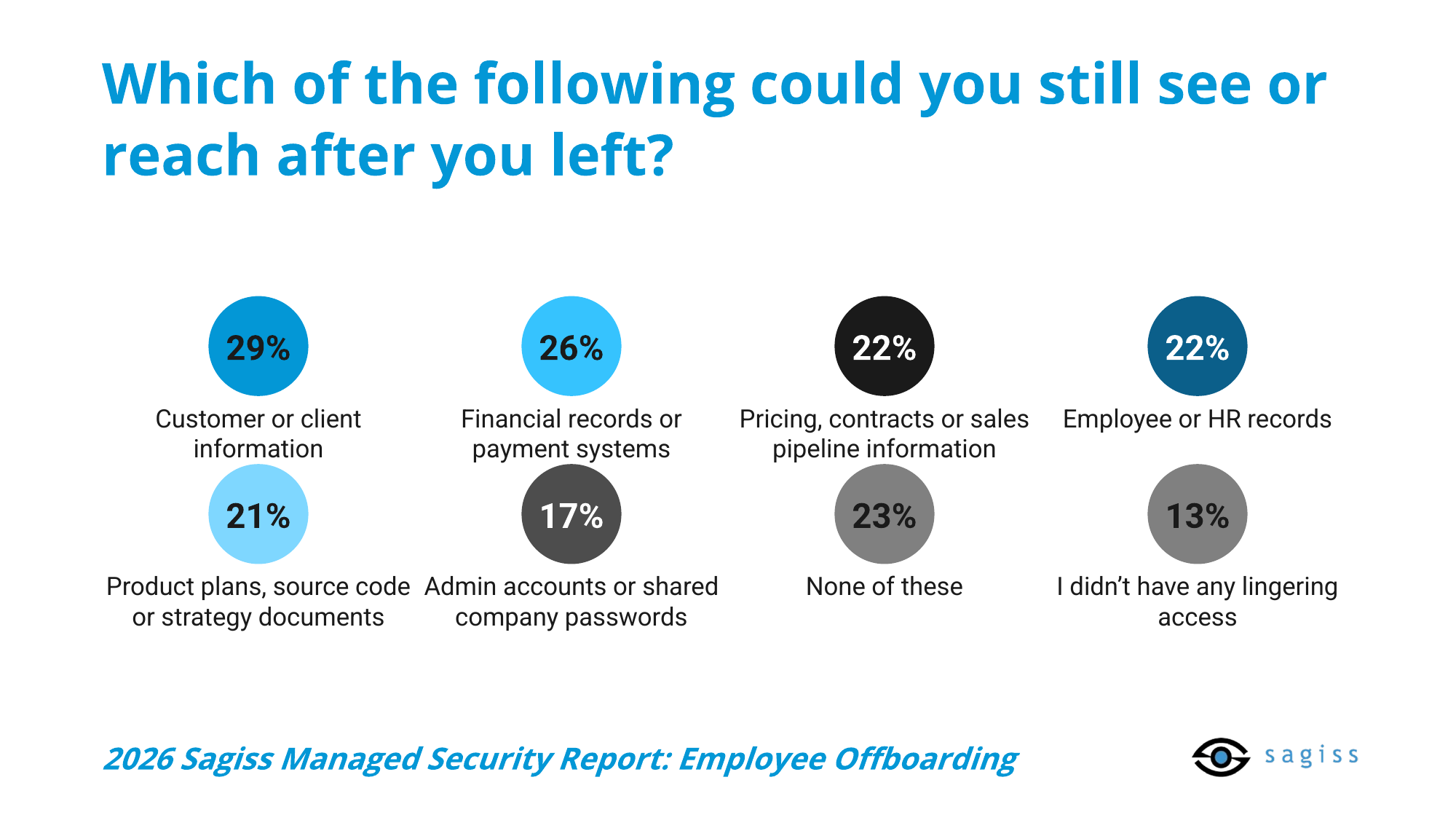
64% of former employees could still reach sensitive company information after leaving, including customer or client information at 29% and financial records or payment systems at 26% (2026 Sagiss Managed Security Report: Employee Offboarding)
When asked to describe the most surprising thing they still had access to, former employees named client databases, company credit and gas cards, payroll systems and other employees’ records. One wrote, “customer database. I could have set up my own company with that information.” Another said they still had records on the person who replaced them, including “address, phone number, email and even his vehicle and license plate number.”
Some access reached into regulated records. Former employees described patient files they could still open and a school system with “student grades, discipline reports, records.” Others still had server and production access. “I still had production access to things and could potentially make changes that would impact clients,” one former employee wrote.
“Most companies are careful about the laptop because it’s sitting on a desk and someone has to physically take it back. The accounts are harder to see, and every app a team adds is one more door that has to be closed when someone leaves,” said Travis Springer, president of Sagiss.
Company information also left with former employees. In all, 71% say company information was still stored somewhere they personally controlled after they left, most often in their personal email (32%) or on a personal computer (29%). Sixteen percent had company information in an AI tool or AI chat history they’d used for work. Even among former employees whose employer asked them to delete or return company files on personal devices, 88% still had company information somewhere they controlled.
Telling the company didn’t always close the gap
31% of former employees who told their old employer their access still worked say it was still working more than a week later.
2026 Sagiss Managed Security Report: Employee Offboarding
Former employees usually found out without looking. Among those with lingering access, 60% learned about it because notifications kept showing up, they logged in out of habit or a former coworker mentioned it or added them to something. A quarter (25%) checked on purpose.
Forty-one percent told their former employer their access was still working. The response was uneven. Only 21% of those who spoke up saw their access shut off the same day, and 31% say it was still working more than a week later.
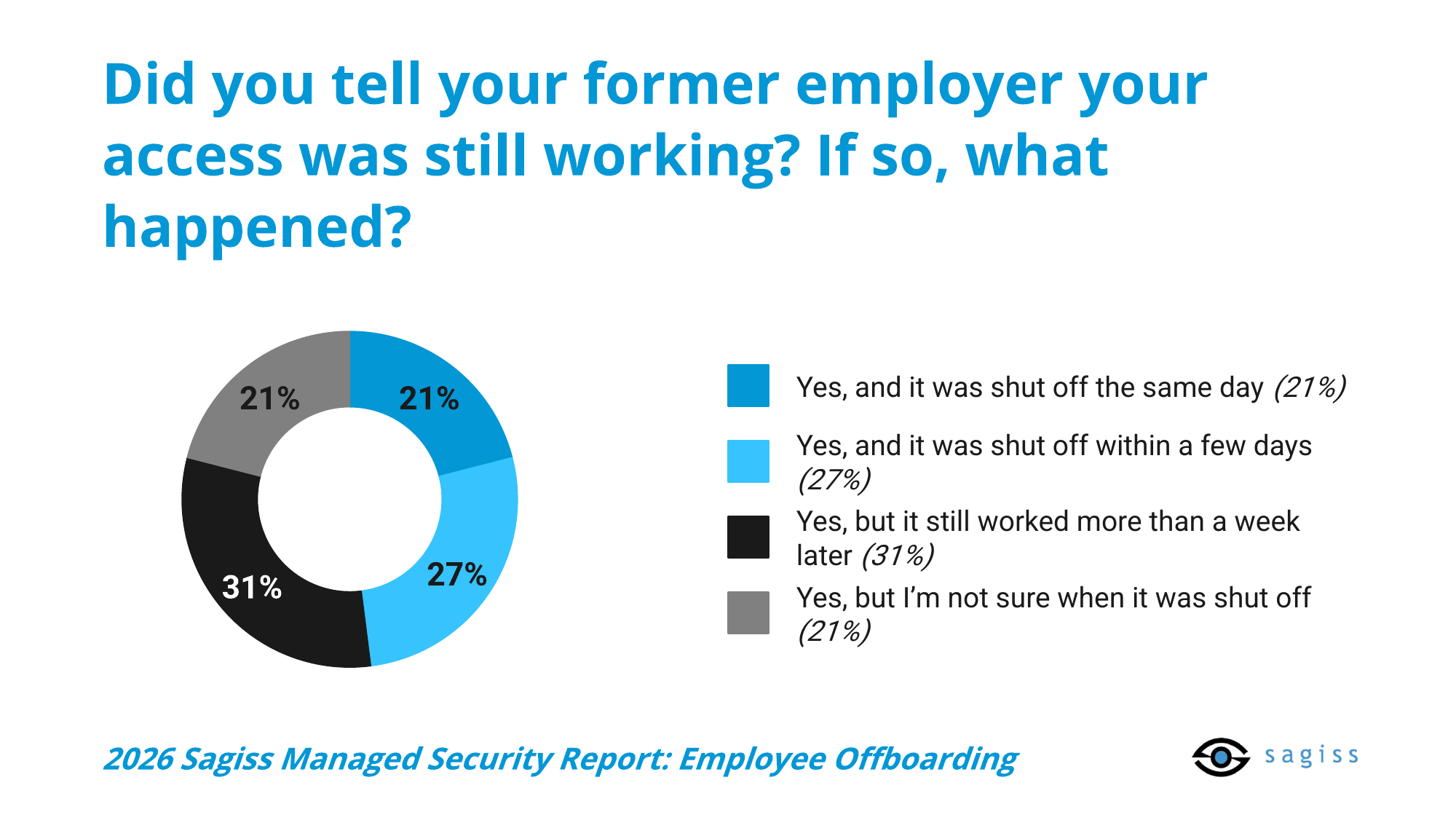
Of former employees who told their old employer their access still worked, 31% say it was still working more than a week later and 21% say it was shut off the same day (2026 Sagiss Managed Security Report: Employee Offboarding)
Another 40% didn’t tell their employer. Their most common reasons were assuming the company would figure it out (43%) and not thinking it was their job to say anything (30%).
Some former employees did use the access. Forty-seven percent have used access to a former employer’s systems after leaving, even briefly. The most common reasons were to see what was still there (16%), to grab personal files or contacts (14%), to help a former coworker or finish a handoff (10%) and for another reason (7%).
The equipment comes back while the accounts stay open
82% of former employees whose employer collected their laptop or other equipment still had at least one account or access point working afterward.
2026 Sagiss Managed Security Report: Employee Offboarding
Collecting equipment was the most common offboarding step, and fewer than three in ten former employees (28%) say their employer did it. Even when employers took back the laptop, the accounts often stayed open. Among those whose equipment was collected, 82% still had access afterward, and 35% could still log in to their work email.
Other steps were less common. Only 20% of former employees were told which accounts would be shut off and when, and 16% had company email or apps removed from their personal phone. A third (33%) say their employer did none of the steps listed in the survey.
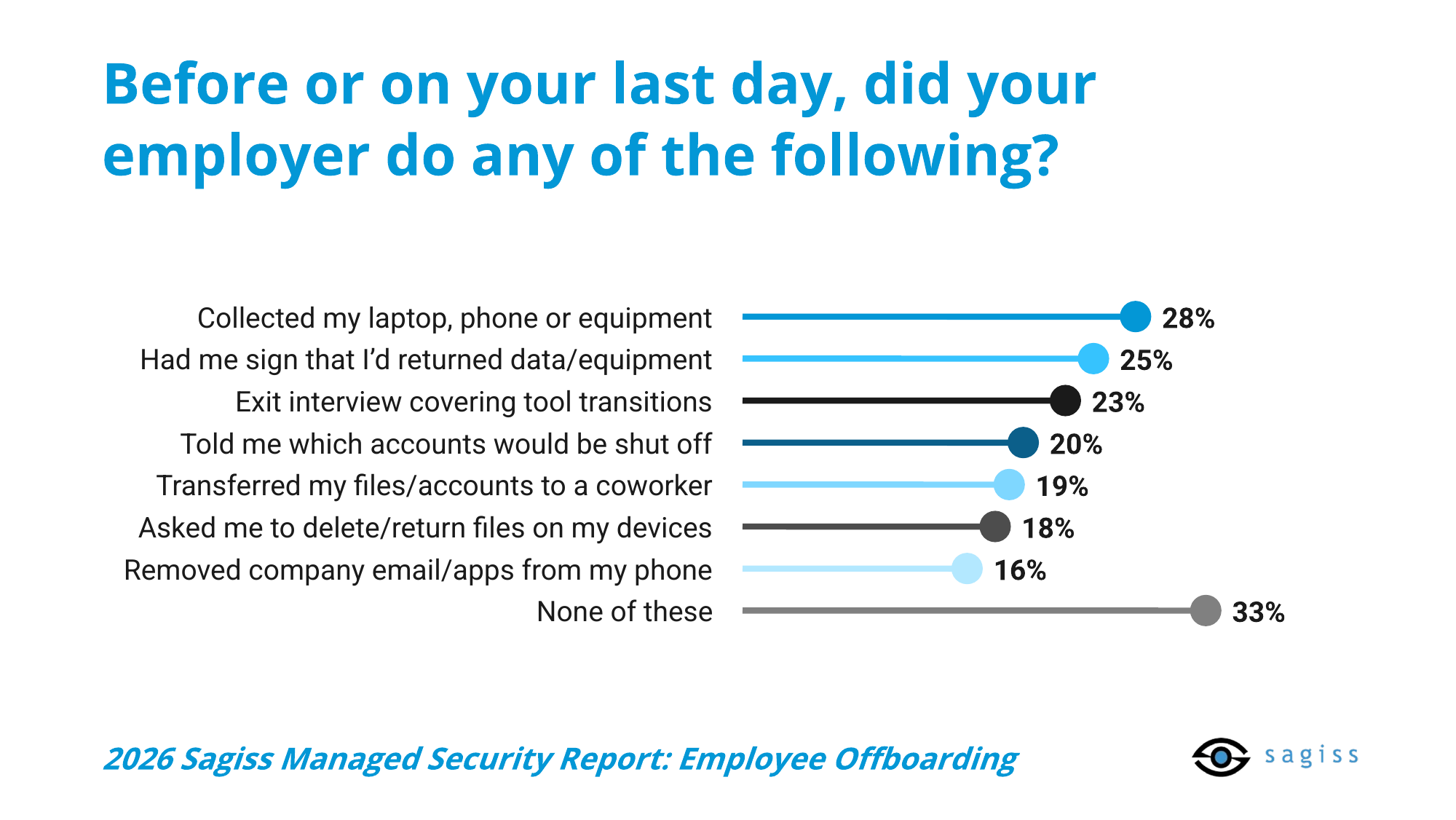
Only 28% of former employees say their employer collected their equipment before they left, and 33% say their employer did none of the offboarding steps listed (2026 Sagiss Managed Security Report: Employee Offboarding)
Responsibility for shutting off access was often unclear. A third of former employees (33%) say it wasn’t clear who was responsible or that no one seemed to be handling it. Among those who could name an owner, the answers split between their company’s IT team (19%), HR (18%), their manager (17%) and another person or team (9%). Only 4% named an outside IT provider.
Layoffs and contract endings left access open longer
59% of former employees who were laid off or let go say their work access remained active until later that day or longer after they were told their job was ending.
2026 Sagiss Managed Security Report: Employee Offboarding
Involuntary exits didn’t move faster. Among former employees who were laid off or let go, 59% say their access remained active until later that day or longer after they were told their job was ending. More than a quarter (27%) say it lasted more than a week or never stopped.
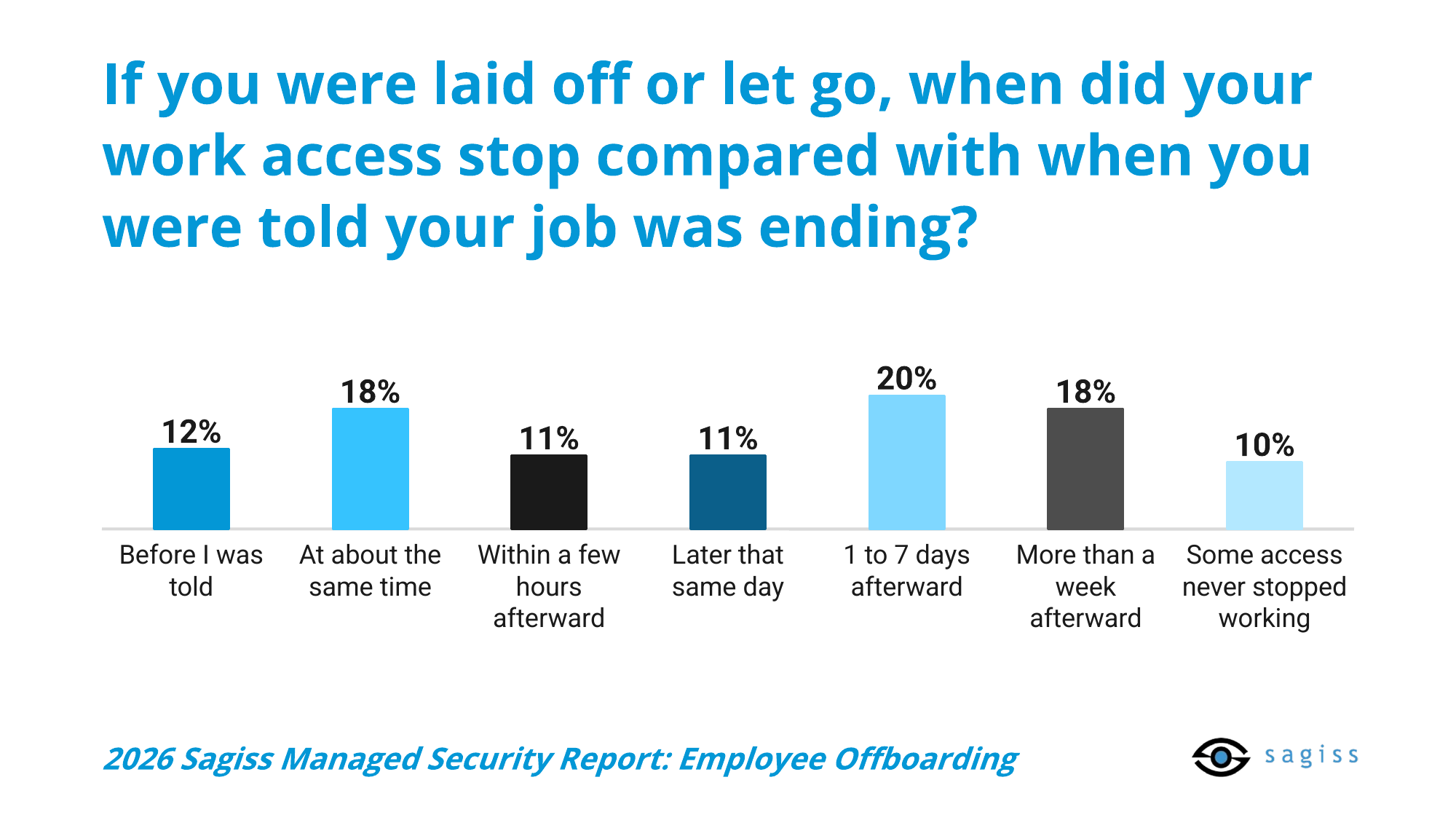
59% of laid-off or fired former employees say their work access remained active until later that day or longer after they were told their job was ending, and 27% say it lasted more than a week or never stopped. (2026 Sagiss Managed Security Report: Employee Offboarding)
Contract and temporary workers had the most access left behind. Among former employees whose contract or temporary role ended, 89% had lingering access and 79% could still reach sensitive company information. Former employees who resigned and those who were laid off or fired reported lingering access at the same rate (78%).
Smaller companies and more apps meant more open access
82% of former employees who left companies with fewer than 250 employees had lingering access, compared with 70% at companies with more than 1,000.
2026 Sagiss Managed Security Report: Employee Offboarding
Company size made a difference. Former employees who left companies with fewer than 250 employees were more likely to have lingering access (82% vs. 70% at companies with more than 1,000) and more likely to still reach sensitive information (67% vs. 51%). Former employees who left companies with 10 to 49 employees had the highest rate of any size group (86%).
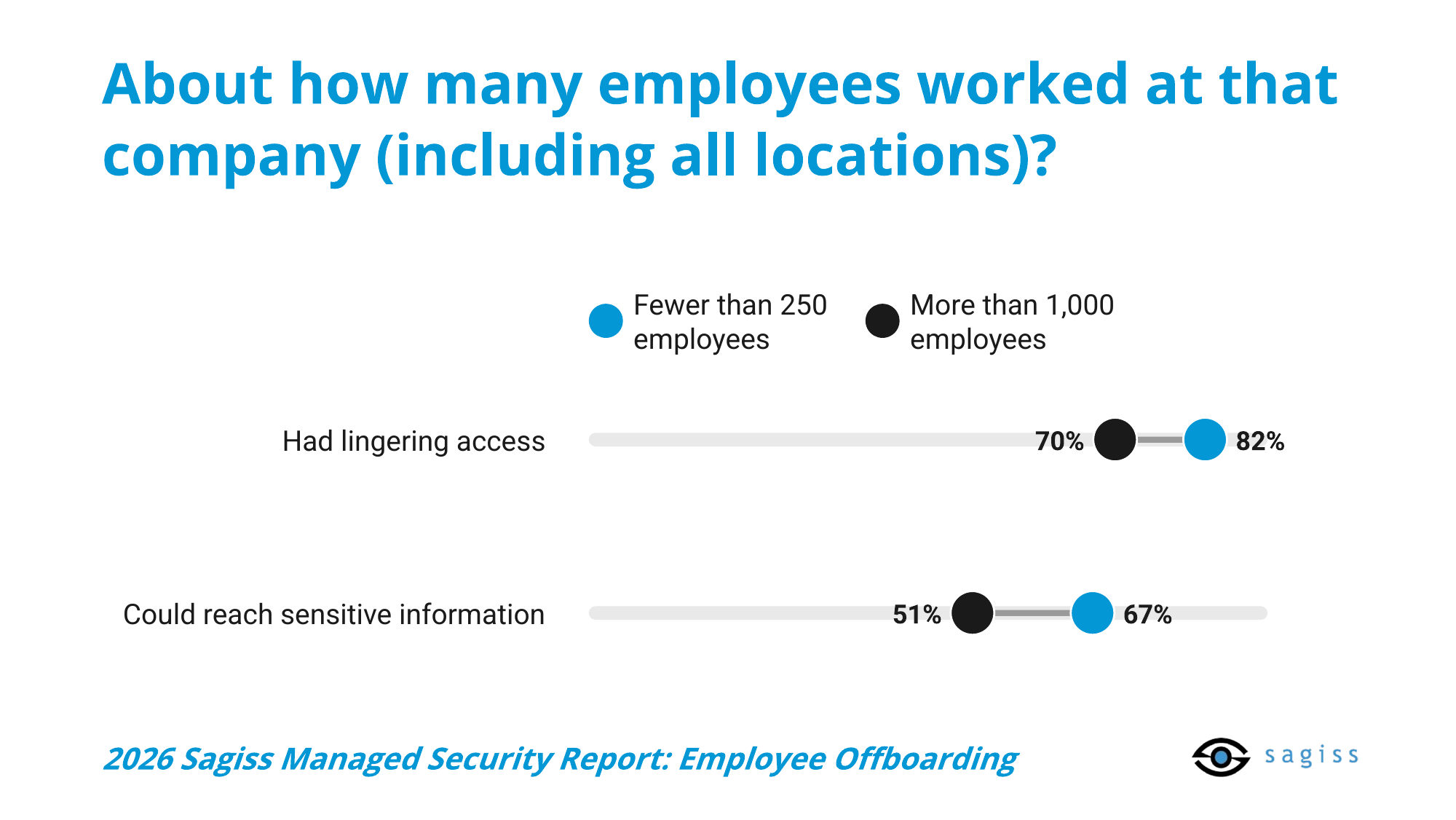
82% of former employees who left companies with fewer than 250 employees had lingering access, compared with 70% at companies with more than 1,000, and 67% vs. 51% could still reach sensitive information (2026 Sagiss Managed Security Report: Employee Offboarding)
The number of apps a job required mattered too. Former employees who used seven or more work accounts or logins had lingering access at a higher rate than those who used one to three (87% vs. 71%). They were also nearly twice as likely to have used that access after leaving (64% vs. 34%).
“Offboarding works when one person owns the full list of accounts and closes every one of them the same day. Most small businesses don’t have that person on staff, so access stays open until someone happens to notice,” said Travis Springer, president of Sagiss.
What employers should do next
Former employees in the survey found open accounts on their own, often weeks after leaving. Sagiss’s post on streamlining employee onboarding and offboarding with an MSP walks through the offboarding steps an IT partner can handle, from revoking access to collecting hardware and deactivating accounts.
Keep a current list of every account each employee uses.
Former employees with seven or more logins had lingering access 87% of the time. The list should include company AI tools and vendor portals along with email and shared drives.
Name one owner for offboarding.
A third of former employees say no one clearly owned shutting off their access. Put one person or team in charge of the full checklist, with a written handoff between HR and IT.
Shut off access on the last day, and at the moment of notice for layoffs.
Among former employees who were laid off or let go, 59% say their access remained active until later that day or longer after they were told their job was ending. Plan the account shutdown before the conversation happens.
Look past the laptop.
Among former employees whose equipment was collected, 82% still had access. Remove company email and apps from personal phones and end any synced sessions. Change shared passwords and door codes when someone leaves.
Get a written process and a partner to run it.
Small businesses had the highest rates of lingering access in the survey. Sagiss’s IT Support Services handle user onboarding and account changes through a dedicated service desk, and Managed Security Services include identity and access hardening with least-privilege administration.
Frequently asked questions about employee offboarding
How common is it for former employees to keep access to work accounts?
Former employees keeping access to work accounts is common. In Sagiss’s survey of 1,000 U.S. adults who left a job, 79% say at least one work account or access point kept working after their last day.
What kinds of access stay open after an employee leaves?
The access that stays open after an employee leaves is most often work email. A third of former employees (33%) could still log in to their work email, and others still had shared files, meeting invites, company AI tools, VPN connections and building badges that worked.
Can former employees still see customer or financial data?
Former employees can still see customer and financial data in many cases. Sagiss’s survey found 29% of former employees could still reach customer or client information after leaving, and 26% could still reach financial records or payment systems.
How long does access last after an employee leaves?
Access often lasts weeks or longer after an employee leaves. Thirty percent of former employees say their access lasted more than a month or still works today.
Do companies shut off access when a former employee reports it?
Companies don’t always shut off access right away when a former employee reports it. Of former employees who told their old employer, 31% say their access was still working more than a week later, and 21% say it was shut off the same day.
Is collecting a laptop enough to offboard an employee?
Collecting a laptop isn’t enough to offboard an employee. In Sagiss’s survey, 82% of former employees whose employer collected their equipment still had at least one account or access point working afterward.
Who is responsible for shutting off an employee’s access when they leave?
Responsibility for shutting off an employee’s access is often unclear. A third of former employees (33%) say it wasn’t clear who was responsible or that no one seemed to be handling it, and those who named an owner split between IT, HR, their manager and other teams.
Do laid-off employees keep access to company systems?
Many laid-off employees keep access to company systems after they’re told. Among former employees who were laid off or let go, 59% say their access remained active until later that day or longer after they learned their job was ending.
Are small businesses more at risk from lingering access?
Small businesses had more lingering access in Sagiss’s survey. Former employees who left companies with fewer than 250 employees had lingering access 82% of the time, compared with 70% at companies with more than 1,000.
What should an employee offboarding checklist include?
An employee offboarding checklist should include every account the employee used and one clear owner for shutting them off. It should also set a same-day shutdown and cover shared passwords and door codes.
Survey methodology
The 2026 Sagiss Managed Security Report: Employee Offboarding surveyed 1,000 U.S. adults who left a job in the past five years that involved computers or company systems. The survey was conducted in September 2026 using Pollfish. It measured which work accounts and systems kept working after former employees left and what their employers did to shut off access.