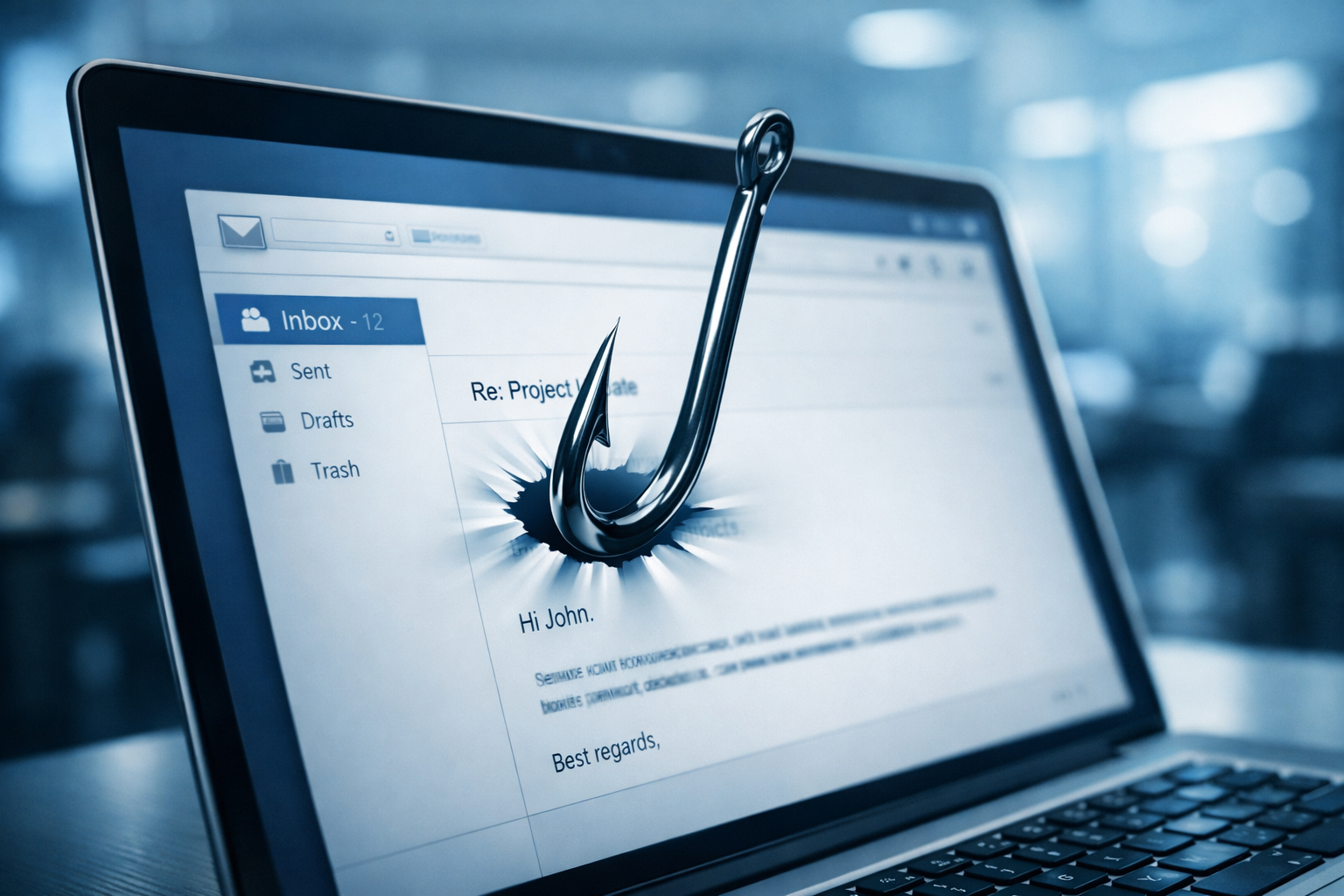
Phishing used to come with built-in, easy-to-spot red flags: awkward phrasing, terrible spelling, generic greetings, and links that didn’t match the sender’s domain. Generative AI erased most of those tells within two years, and AI phishing statistics for 2026 show how much progress cyberattackers have made as a result. Messages that once took an attacker hours to write now take minutes. Where voices once required studio equipment to fake, cybercriminals can now clone with just a few seconds of audio.
Unfortunately, small and midsize businesses (SMBs) without dedicated security teams are absorbing a disproportionate share of the damage. Larger organizations typically have layered defenses, such as security operations centers, dedicated incident response teams, enterprise-grade filtering tools, and the budget to keep all of it current. SMBs rarely have any of those things in place, which makes them structurally easier to breach. Attackers understand this, and since AI-generated phishing campaigns can now be deployed at scale with minimal effort, targeting hundreds of small businesses simultaneously costs little more than targeting one.
In this roundup, we’ve compiled the numbers that IT leaders, journalists, executives, and operations teams need to understand this threat. We’ll show you where AI phishing stands today, including fresh data from our 2026 workplace survey, and what it means going forward.
The AI Phishing Threat in 2026: No Longer Emerging
Security teams spent the past few years describing AI-enabled phishing as an emerging threat. At this point, that threat has come into its own, as the 2026 Sagiss survey on AI phishing in the workplace clearly shows. Seventy-two percent of respondents acknowledge that phishing attempts have become more convincing than they were a year ago because of AI-written language.
Global organizations also recognize the threat. The World Economic Forum’s Global Cybersecurity Outlook 2026 found that cyber-enabled fraud overtook ransomware as the top concern among CEOs worldwide. A full 73% of respondents reported that they or someone in their network experienced this kind of fraud in 2025.
Attackers don’t even need to have their own sophisticated skills to launch these attacks. Phishing-as-a-service platforms have made enterprise-grade attack tools available to virtually anyone willing to pay a subscription fee. Kali365, a platform the FBI flagged in May 2026, is one stark example. It was distributed on Telegram and available to affiliates for as little as $250 for 30 days of access. Kali365 is designed to bypass multi-factor authentication by abusing legitimate Microsoft device authorization pages, granting attackers persistent access to Microsoft 365 accounts without ever stealing a password. Once inside, that access can be used for data theft, fraud, extortion, or as a foothold for a ransomware deployment. The barrier to launching a sophisticated phishing campaign has never been lower, which means the volume of attacks SMBs face will only continue to grow.
SMBs should pay particular attention to these figures because AI-fueled fraud campaigns propagate faster than the security awareness training most companies rely on. Sagiss found that employees at small and midsize businesses routinely encounter AI-generated scams. The threat has transformed from theoretical to operational, and AI-powered cyberattacks statistics for 2026 illustrate the extent of the problem.
AI Adoption by Attackers: 82.6% of Emails Now AI-Generated
According to KnowBe4’s 2025 Phishing Threat Trends Report, 82.6% of phishing emails contain AI-generated content. Two years ago, AI usage in phishing was in its infancy. Through 2024, attackers experimented with large language models, moving to production use through 2025, and by the year’s end AI-written messages had become the default rather than the exception.
The seasonal data even more starkly highlight the trend. AI-generated phishing volume escalated 14-fold over the 2025 holiday season, rising from roughly 4% to 56% of phishing emails. Attackers deployed newly accessible generative AI tools to evade security filters and exploit holiday urgency through fake package-tracking alerts, last-minute gift deals, and urgent travel notifications.
With these alarming AI phishing statistics coming to light, it’s clear that today’s SMBs face more fraud and loss exposure than ever.
AI Phishing Effectiveness: The 4x Multiplier
Harvard Business Review research on AI-driven social engineering, published in 2024, found that AI-generated phishing emails produce a 54% click rate, compared with 12% for traditionally written phishing emails. That’s more than four times the former response rate. And the social engineering statistics on credential theft show an even wider gap. With traditional phishing, just 7.5% of recipients who click go on to enter credentials. In AI-generated phishing attacks, 33.6% of recipients who click also enter credentials.
The reason is that it’s incredibly easy for large language models to make convincing false websites and personalize messages at scale. LLMs can read a target’s public profile, recent posts, and writing style, then generate a message that mirrors a co-worker’s tone or a vendor’s typical phrasing. Employees who would otherwise recognize a generic “verify your account” email will more likely click through when the message references their actual project or department manager.
What Workers Are Seeing: Exclusive Data From the Sagiss Survey
Sagiss, in partnership with Pollfish, surveyed 500 U.S. desk-based workers directly about how they’re handling the rapidly increasing danger of AI-powered phishing landmines. In the 2026 Sagiss phishing survey, 64% of respondents believe an AI-generated message could impersonate a co-worker convincingly enough to fool them.
Asked what changes they’ve seen in latter-day phishing messages, 33% of the surveyed workers mentioned better grammar and spelling, and 27% noted that messages now feel unsettlingly personalized.
Those perceptions highlight a problem that goes beyond awareness. Workers already sense that phishing is getting harder to detect, and the conditions of modern work make careful verification even harder to practice consistently. Sixty-three percent of respondents clicked a work-related link in the past year and later felt they should have double-checked it first. Fifty-seven percent have verified a message’s request only after taking action, and 45% have replied to a work email or chat and later questioned whether it was legitimate. These patterns play out across organizations every day.
Workplace pressure is a significant part of why, with 68% of workers checking work email or chat outside normal business hours at least sometimes, and 56% feeling pressure to respond after hours. Fatigue and divided attention are reliable allies for attackers. When someone is catching up on messages at 9 p.m., the deliberate pause that good security judgment requires is the first thing to go. Plus, 37% of respondents said suspicious messages are hardest to verify precisely when they look legitimate and well-written, which is increasingly the norm. The most dangerous phishing messages today are the ones that give employees the least reason to stop and question them.
Multi-Channel AI Attacks: Email, Voice, and SMS
When it comes to phishing attack vectors, email gets most of the attention, but voice and text channels show some of the steepest increases. Voice phishing, or vishing, attacks rose 442% year over year, SMS phishing now accounts for 35% of phishing attempts, and callback phishing schemes grew 500% as attackers combine channels within a single attack chain.
Voice Phishing (Vishing): 442% YOY Surge
Modern voice cloning tools need as little as three seconds of audio to produce a convincing replica of someone’s voice. They can collect audio from something as innocuous as a voicemail greeting, a conference recording, or a video posted online. Attackers combine that capability with caller ID spoofing to impersonate executives, vendors, co-workers, or family members in real time.
The most widely reported example combined voice and video. In 2024, an employee at the British multinational engineering firm Arup transferred $25 million after joining a video call where every other “colleague,” including the CFO, was an AI-generated deepfake. The call convinced an employee, who had initially suspected that the email they received was a phishing attempt.
The Arup case demonstrates why, even with voice and video verification, you can no longer rule out impersonation. Criminals can now fake both, along with the email initiating the request.
SMS Phishing (Smishing): Bypassing Email Filters
Smishing now accounts for 35% of all mobile phishing attempts. The 2026 Verizon Data Breach Investigations Report stated that smishing yields a 40% higher median click rate than traditional email phishing attempts.
Most SMBs build spam filtering, link scanning, and security awareness training around email, but provide far less coverage for text messages. A text claiming to be from a delivery service, a bank fraud team, or even an internal IT helpdesk may easily get through on a personal device that company security tools never touch.
That’s why BYOD policies create vulnerability. When employees use personal phones for work communication, those devices exist almost entirely outside the organization’s security perimeter. There’s no corporate endpoint protection, mobile device management policy enforcing security standards, or visibility for IT teams when something goes wrong. An attacker doesn’t need to defeat a company’s email security stack if they can just reach an employee’s personal phone directly.
AI usage only bolsters the problem. Short-form text is easy for language models to generate at a large volume, and the brief, urgent, typo-tolerant format dovetails perfectly with how people write and read texts. The format itself nefariously camouflages any poor grammar or other obvious signals of fraud.
Financial Impact: What AI Phishing Costs SMBs
AI phishing statistics show that phishing costs continue to climb. Experts estimate that AI-enabled fraud losses surged 1,210% in 2025. Global annual losses from this category are now approaching $25 billion. According to IBM’s 2025 Cost of a Data Breach report, breaches starting with phishing now cost $4.8 million on average, roughly in line with the global average across all breach types.
Business email compromise (BEC) alone accounted for $2.77 billion in losses reported to the FBI’s Internet Crime Complaint Center in 2024, the second-highest total of any fraud category that year.
Those losses resulted from a relatively small number of incidents. BEC relies on convincing a single employee to wire money just once, which makes the cost calculation different from a typical data breach. One fraudulent email getting through can cost more than a full year’s worth of security spending.
The headline figures, however, only capture the most direct and measurable losses. The full cost of a phishing incident spreads across categories that are harder to quantify but no less real. Operational downtime begins the moment a breach is detected. Systems go offline, employees lose access to critical tools, and IT resources shift entirely to containment and recovery. Add forensic investigation, legal notification, and regulatory compliance obligations on top of that. For industries subject to HIPAA, PCI-DSS, or state-level privacy laws, a breach triggered by a single phishing email can generate regulatory penalties that dwarf the original fraud loss.
Then there is the reputational damage. Clients and partners who learn that their data was exposed through a vendor’s compromised email system don’t always wait for a remediation update before taking their business elsewhere. SMBs often build client relationships on personal trust and referrals, so that erosion can be the most lasting consequence of all. It may never show up in an insurance claim but it impacts revenue for years after the incident itself has been resolved.
Why Traditional Detection No Longer Works
For two decades, online security awareness training was basically an unchanging checklist that told users to look for:
- Spelling errors
- Generic greetings
- Incorrect logos
- Mismatched URLs
- Urgent demands from unfamiliar senders
That checklist assumed attackers had limited language skills and limited time. Once upon a time, that may have been true, but neither assumption holds water anymore.
AI tools translate languages, fix grammar automatically, pull company branding from public websites, and reference real names, projects, and dates culled from social media and old data leaks. The red flags people spent years learning to detect are the simplest things for AI to remove.
In our own study, 37% of workers said that when a message looks and reads like it’s legitimate, they have no reliable way to verify it before acting.
The formerly foolproof checklist is officially obsolete.
How SMBs Can Defend Against AI-Powered Phishing
Employee training still has its place, but it can’t bear the same weight it previously did. The more useful strategy now, rather than teaching your people how to spot fakes, is to build procedural controls that don't depend on human fraud detection.
Three particular controls that SMBs should consider right now are:
- Phishing-resistant multi-factor authentication (MFA): This involves hardware keys or passkeys that can’t be relayed or replayed, unlike the “one-time codes” that AI-driven phishing outfits can already intercept in real time.
- Out-of-band verification: Any request involving money, credentials, or access changes requires independent second-channel confirmation, such as approving a login or transaction via an independent authenticator app.
- Behavioral and transaction controls: These can include dual approval for wire transfers or alerts for unusual login locations or times. This prevents a compromised account or individual from moving money or sharing data without a failsafe.
These fraud prevention methods don’t depend on a person correctly judging whether a message “feels” real, judgments which, as the 2026 Sagiss phishing survey found, are no longer reliable.
For SMBs wondering whether their cybersecurity protocols provide adequate protection, managed security service can be the answer to sleeping well at night. Sagiss provides outsourced, enterprise-grade cybersecurity that includes threat detection, employee training, data backups, email and web security, and regulatory compliance so your team doesn’t have to. Reach out today for a consultation about managed security for your small business.
 Travis Springer
 Travis Springer : June 29, 2026 at 8:15 AM