 Sagiss, LLC
Cost is one of the first questions small businesses ask when evaluating managed IT services. In a market as active as Dallas-Fort Worth, pricing can vary widely depending on the provider, service model, and level of support. Understanding how managed IT is priced helps business owners make informed decisions and avoid surprises later.
Managed IT is designed to provide predictable support, stronger security, and access to expertise that would be difficult to build internally. The way those services are priced plays a direct role in how well they align with your business needs.
Managed IT Services Pricing in Dallas-Fort Worth (2026)
Quick numbers:
- Fully managed IT: $150–$175/user or device per month.
- Co-managed IT: $50–$100/user or device per month.
- In-house alternative: $100,000+ per year per senior hire, before benefits, software licensing, and required IT tools.
See breakdown below.
Most managed service providers structure pricing around a fixed monthly fee. This is often calculated per user or per device. The goal is to create a predictable cost that covers ongoing support, monitoring, and maintenance.
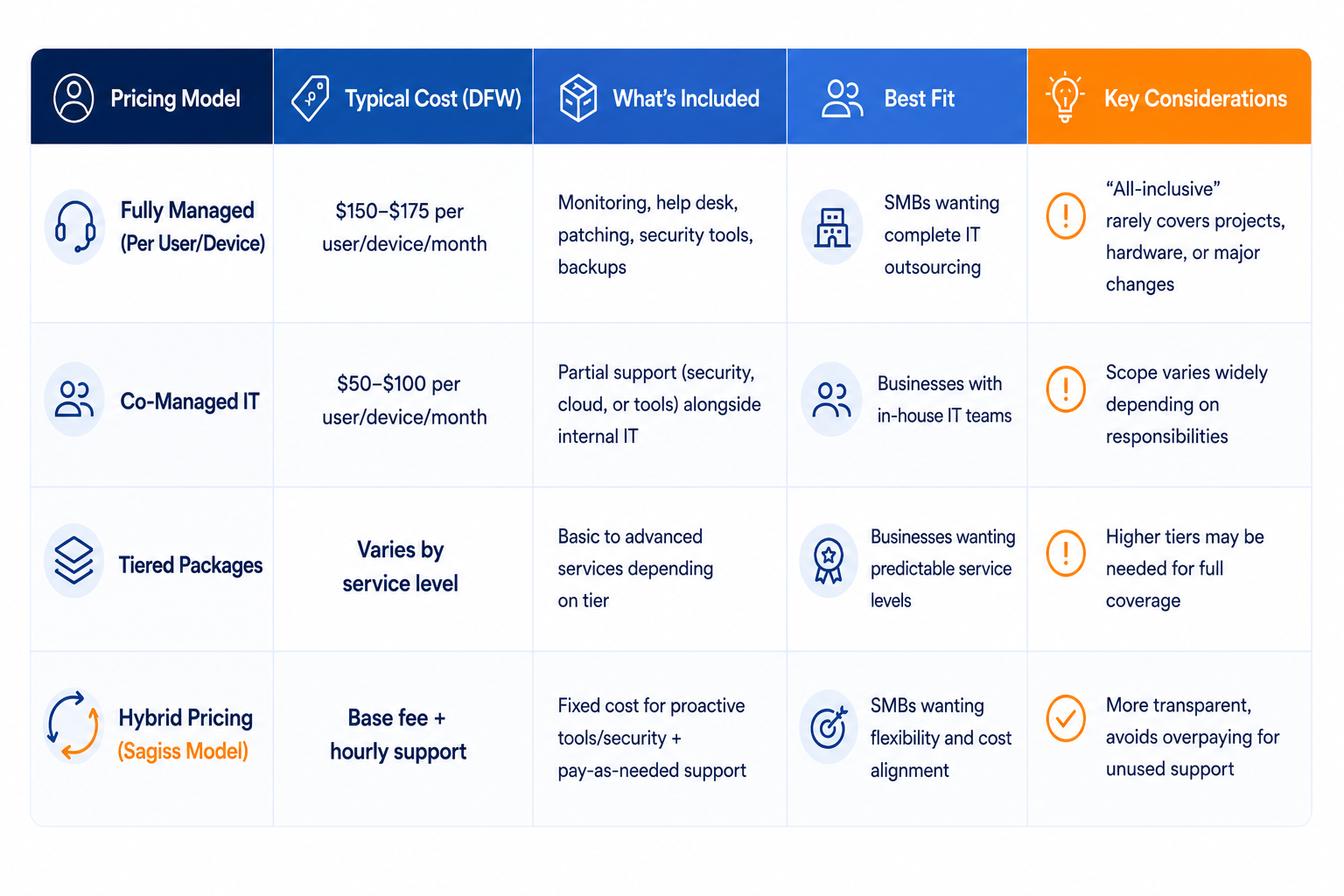
According to Sagiss, a Dallas-Fort Worth managed IT provider, fully managed IT in the DFW market typically runs $150–$175 per user or device per month. . This level of service usually includes proactive monitoring, cybersecurity tools, patch management, and help desk support.
Co-managed IT follows a different model. Businesses with internal IT staff may only need support in certain areas such as security or managed cloud services. In these cases, pricing often falls between $50 and $100 per user or device, depending on the scope of services provided.
These ranges reflect averages for the region. Actual pricing depends on factors such as infrastructure complexity, compliance requirements, and the number of users supported.
Managed IT Pricing Models: Per user, Per device, and Tiered
While per-user pricing is the most common approach, it’s not the only option. Understanding the different models can help you evaluate proposals more effectively.
- Per-user pricing assigns a monthly cost to each employee supported. This model works well for businesses where employees use multiple devices and require consistent access to IT resources.
- Per-device pricing charges based on the number of computers, servers, and other endpoints. This can be a good fit for organizations with shared workstations or specialized equipment.
- Tiered pricing offers different service levels at different price points. Basic tiers may include monitoring and maintenance, while higher tiers add advanced security or strategic planning.
Many providers promote “all you can eat” pricing, suggesting that everything is covered under a single monthly fee. In practice, there are always services that fall outside the standard agreement. Hardware purchases, software licensing, major projects, and onboarding or offboarding tasks are typically billed separately.
What’s Included in Managed IT, and What Costs Extra
A managed IT agreement usually covers the core services needed to keep systems running securely and efficiently. These often include monitoring, patching, antivirus protection, backup management, and access to a help desk.
Beyond that foundation, additional services may be billed separately. Cloud migrations, infrastructure upgrades, compliance consulting, and advanced cybersecurity tools are often treated as add-ons. The same applies to project-based work such as network redesigns or office relocations.
Understanding these distinctions is important when comparing providers. A lower monthly fee may not reflect the total cost if many essential services are excluded.
Why Fixed-Fee IT Pricing Can Work Against You
Fixed-fee models aim to create predictability, but they can be challenging to balance over time. If pricing is set too high, the client may end up paying for capacity they don’t use. If it’s set too low, the provider may struggle to maintain service quality.
This dynamic can lead to misalignment. Businesses may feel they’re overpaying, while providers may limit support to protect their margins. Over time, that tension can affect the overall partnership.
Some providers have introduced hybrid pricing models to address this challenge. Sagiss, for example, combines a fixed monthly fee for proactive tools and security with hourly billing for reactive support. This approach ensures that foundational services are always in place while allowing flexibility for changing support needs.
Hybrid pricing can be especially useful in co-managed environments, where internal teams handle certain responsibilities and rely on external support for others. It creates a structure that adapts as the business evolves.
Managed IT vs. In-House IT: Cost Comparison for DFW Businesses
Hiring internal IT staff is another option, though it often comes with higher costs and less flexibility. A single experienced IT professional in Dallas-Fort Worth can command a salary well into six figures when benefits and overhead are included.
Beyond salary and benefits, in-house IT comes with additional costs that are often overlooked. An internal hire still requires a full stack of tools to do their job effectively, including backup solutions, network monitoring, endpoint security, and software licensing. These tools can add up quickly, especially for small and mid-sized businesses that purchase them in limited quantities and don’t benefit from volume pricing. As a result, the true cost of in-house IT is often significantly higher than the base salary alone.
Building a full team with expertise in networking, cybersecurity, and cloud services can quickly exceed the budget of most small businesses.
Managed IT services provide access to a broader range of skills at a predictable cost. Instead of relying on one individual, businesses gain a team with specialized expertise across multiple areas.
There are also indirect cost savings to consider. Reduced downtime, improved system performance, and stronger security all contribute to better business outcomes. These factors often outweigh the difference in monthly service fees.
Choosing a Managed IT Provider in Dallas-Fort Worth
The Dallas-Fort Worth market has unique characteristics that influence IT pricing and service expectations. Businesses often operate across multiple locations and require fast response times when issues arise. Local presence can play an important role in meeting those expectations.
Providers based in the region can offer on-site support when needed and develop a deeper understanding of the local business environment. This can lead to more responsive service and stronger long-term relationships.
It’s also important to consider how pricing aligns with your growth plans. A model that works for a small team today should still make sense as your business expands. Flexibility, transparency, and alignment with your operational needs are key factors in making the right choice.
Finding the Right Balance
While finding the lowest cost is important, it’s not the only factor to consider when evaluating managed IT pricing. The most important thing is finding the right balance between value, flexibility, and support. A well-structured agreement should provide clarity on what is included, how additional services are handled, and how costs may change over time.
Businesses that take the time to understand pricing models and evaluate providers carefully are more likely to find a partner that supports their long-term success. In a competitive market like Dallas-Fort Worth, that partnership can make a meaningful difference in how technology supports growth and resilience. Sagiss can be that partner. Schedule a consultation with us to learn how.
Frequently Asked Questions
How much does an MSP cost per month?
In the Dallas-Fort Worth market, fully managed IT services typically run $150–$175 per user or device per month. Co-managed IT, for businesses that already have internal IT staff, generally falls between $50 and $100 per user or device. The total monthly cost depends on your team size, infrastructure complexity, and which services are included in the base agreement.
Is managed IT worth it for small businesses?
For most small businesses in DFW, yes, particularly when compared to the cost of in-house IT. A single experienced IT hire can cost $130,000 or more annually once salary, benefits, and overhead are included. Managed IT delivers broader expertise at a predictable monthly cost, with the added benefit of proactive security monitoring that a solo hire typically can’t match.
What is the difference between managed IT and co-managed IT?
Fully managed IT means the provider handles all of your technology support, monitoring, security, help desk, and maintenance. Co-managed IT is a partnership model where an internal IT person or team handles some responsibilities while the provider fills gaps in areas like cybersecurity, cloud management, or after-hours support. Co-managed pricing is lower because the scope is narrower.